ThermcircleReview: Full Breakdown of The RM Circle Compensation Plan and Ownership
This thermcircleReview examines The RM Circle, a Polygon-based referral matrix program. It runs as a dApp where users pay POL tokens to join tiers and advance by recruiting others. The focus here is the complete compensation structure and the limited public details on ownership and promoters. All points come from on-chain mechanics, public team materials, and available background records. The goal is clear, practical information for anyone considering participation. Scams radar
Part: 1 What The RM Circle Actually Is
Table of Contents
Users connect a wallet such as MetaMask or Trust Wallet on Polygon Mainnet. They choose Standard (about 181 POL) or Premium (about 362 POL). Premium pays exactly twice Standard at every level. A referrer ID is required. Payments move peer-to-peer through a verified smart contract. The contract holds no large balance; funds flow directly according to programmed rules.
There is no separate retail product sold to outside customers. The main activity is recruiting and upgrading. Team tools include training materials, promo videos, dashboards, QR printables, and an AI coach. These support recruitment rather than generate independent sales revenue.
The project is young. The domain and contract both appeared in late May 2026. As of early September 2026 the operating history remains short.
1.1 Complete Compensation Plan Explained
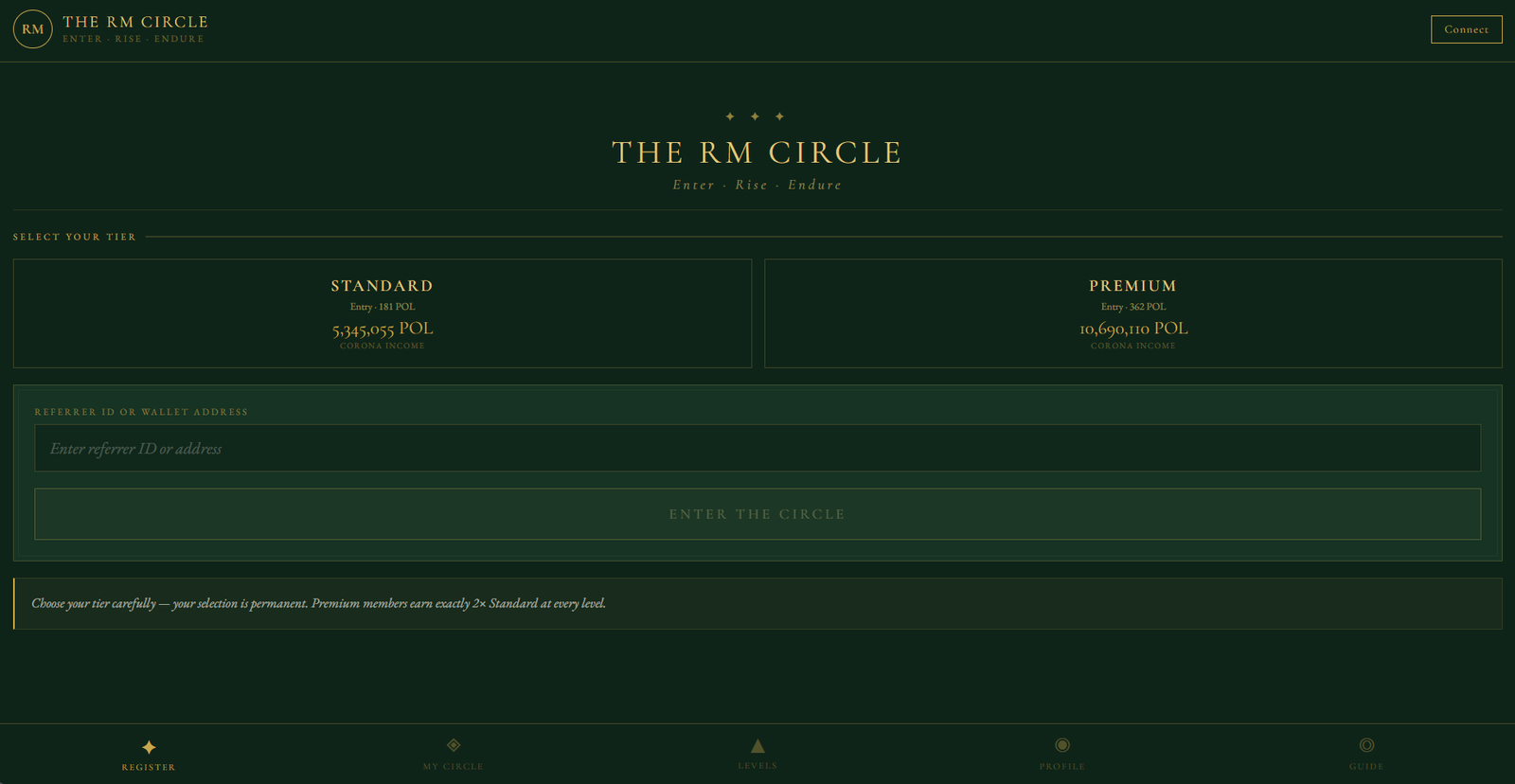
The plan is a 2-wide matrix with eight levels: Scintilla, Ascensus, Fabrica, Culmen, Apex, Fastigium, Vertex, and Corona. The core instruction is “Get your 2. Help your 2 get their 2.” After two qualifying directs, the next upgrade can appear self-funded from the referral commissions.
1.2 Fee split on entry
- Referrer / upline: 95%
- Founder 1: 1%
- Founder 2: 1%
- Development: 3%
- Plus a 5% admin surcharge paid by the new joiner
Upgrade payments go to qualified uplines according to position and level rules.
1.3 Premium upgrade costs (approximate, drawn from contract functions)
Level | Upgrade Cost (POL) | Cumulative Cost (POL) |
Entry | 360.58 | 360.58 |
Ascensus | 621.40 | 981.98 |
Fabrica | 1,242.80 | 2,224.78 |
Culmen | 2,485.61 | 4,710.39 |
Apex | 4,971.22 | 9,681.61 |
Fastigium | 9,942.44 | 19,624.05 |
Vertex | 19,884.88 | 39,508.93 |
Corona | 39,769.75 | 79,278.68 |
Two Premium directs produce roughly 652 POL in referral share. That covers the next upgrade of about 621 POL and leaves a small remainder. This creates the “self-funding” appearance. The money still originates from new participants.
Theoretical Corona figures shown on the interface reach about 5.3 million POL (Standard) and 10.7 million POL (Premium). These are maximums that assume a completely filled matrix under the position. They are not guaranteed or typical outcomes.
Part: 2 Matrix size illustration
Generation 1: 2 positions
Generation 2: 4
Generation 3: 8
… up to Generation 8: 256
Total downstream positions in one full eight-level structure: 510.
Filling that structure requires exponential growth. Further generations quickly demand thousands then millions of participants. No external yield source (real estate, trading profits, product sales, or audited DeFi revenue) has been shown to support the theoretical payouts. All documented money movement is participant-to-participant.
2.1 Ownership Profiles and Backgrounds
Public corporate registration, named directors, or audited financials linked to the project are not available. The smart contract uses labels such as Founder 1, Founder 2, and Development for wallet addresses. These wallets receive the small percentage cuts. Real-world identities controlling them are not disclosed on the dApp or related sites.
The strongest public operational link is Marty Bostick. Team administration pages connect to marketingwithmarty.com domains, default emails, Telegram tools, and sponsor rotation systems that explicitly reference the RM Circle referral structure. Marty Bostick is a long-time internet marketer based in Alabama. Public profiles show an IT and database career beginning in 1989 and internet marketing activity since the mid-1990s. He has sold affiliate products on WarriorPlus (traffic tools, email arbitrage, ranking software) and more recently launched an AI copywriting tool called Branded Voice. He also runs crypto team-build Telegram groups.
Marty is best described as a key promoter and infrastructure operator associated with the ecosystem. Independent evidence does not prove he is the legal owner of the smart contract or the controlling entity. Other promoters such as Jamie Soriano appear in Telegram channels that push the opportunity alongside other online-income programs. Their role is marketing, not proven ownership.
Domain WHOIS data is privacy-protected. The contract deployer wallet is public but not tied to a verified individual in open records. No confirmed criminal convictions or regulatory actions against the identified promoters appear in the reviewed public sources. The short project age and lack of named corporate accountability remain notable.
2.2 Risk Factors and Comparisons
Recruitment must continue for payouts to continue. When new entries and upgrades slow, upline income declines. Blockchain verification confirms the code matches the source and payments execute automatically. It does not create new economic value or guarantee participants recover their contributions.
Typical annual benchmarks for comparison:
- Developed-market real-estate net yields: often single digits
- Bank or high-yield savings: low single digits depending on rates
- Established crypto staking on major platforms: usually low-to-mid single digits for lower-risk assets
The RM Circle theoretical multiples depend on network growth rather than productive assets. Most participants in similar matrix programs historically finish below their total outlay once expansion slows.
Final Assessment
The RM Circle is a high-risk, recruitment-dependent crypto matrix program on Polygon. The compensation plan is transparent in its rules and runs through a verified smart contract. Ownership transparency is low. Marty Bostick’s long marketing background and operational ties are the main public thread, yet legal ownership stays unclear.
Anyone reviewing this thermcircleReview should treat every contribution as money that can go to zero. Reconstruct member counts, upgrade volumes, and actual payouts directly from the blockchain rather than from promotional dashboards. Safer alternatives exist in regulated savings, diversified funds, or audited protocols with visible external yield sources.
Aevos Review
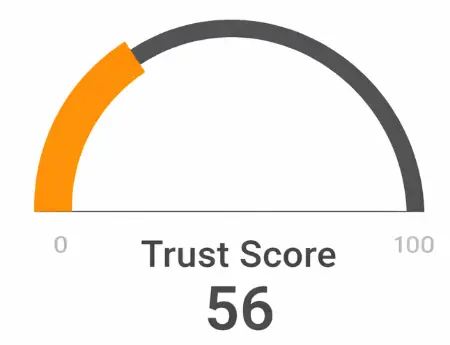
A website’s trust score is an important indicator of its Thermcirclencludes low web traffic, negative user feedback, potential phishing risks, undisclosed ownership, unclear hosting details, and weak SSL encryption.
With such a poor trust score, the likelihood of fraud, data breaches, or other security issues is much higher. It is crucial to carefully assess these warning signs before engaging with SThermcircleimilar platform.
Positive Highlights
- We found a valid SSL certificate
- DNSFilter labels this site as safe
Negative Highlights
- The Tranco rank (how much traffic) is rather low.
- The age of this site is (very) young.
Frequently Asked Questions AboutThermcircle
This section answers key questions about Thermcircleconcerns, and highlights issues related to the platform’s legitimacy.
Check its ownership, registration, transparency, and user feedback before investing.
Review its stated revenue sources and verify whether its return claims are realistic.
Potential risks include high-return claims, limited transparency, and referral-based incentives.
There is no verified connection unless supported by reliable evidence.
Research the platform carefully and assess the risks before investing.
Other Infromation:
WHOIS data : Hidden
Owner : REDACTED FOR PRIVACY
Country: US
WHOIS Registration Date :2026-01-15
WHOIS Last Update:2026-03-27
WHOIS Renew Date: 2028-01-15
Website:Thermcircle
Title :Thermcircle
Reviews:
There are no reviews yet. Be the first one to write one.