SwapLite Review 2026: Is SwapLite Legit or a Scam? Full Analysis of Ownership, Compensation Plan and Risks
This SwapliteReview examines the claims, structure and risks of the SwapLite platform so readers can decide for themselves. The site markets AI-powered Litecoin arbitrage with daily returns. Independent reports link it to earlier high-yield projects that faced payout problems. Below is a clear look at the ownership background, full compensation plan, mathematical limits of the returns, red flags and practical guidance.Scamsradar

Part : 1 Ownership Profile and Background
Table of Contents
The domain was registered on 6 September 2026. Ownership details are hidden behind privacy services. The site states it is a UK-registered company but provides no public company number, director list or verified address on the main pages. The registered office is listed as available only upon legal request.
Public records connect the earlier project SwapTron to SWAPTRON LTD (UK company number 17260034). That company was incorporated on 3 June 2026. Alexander Junior Brown is recorded as the director and person with significant control (75 percent or more of shares and voting rights). The company is classified under fund management activities. Brown was presented as the founder of SwapTron. No public document confirms he is the current legal owner or director of the new platform. No verified criminal convictions for fraud or related offences appear in the available records for him.
The sequence of projects is notable. SwapGain promoted similar AI-arbitrage returns before reports of non-payment in April 2026. SwapTron followed with TRX deposits and the same daily-return model. Public complaints about delayed or missing payouts on SwapTron appeared in early September 2026. The new Litecoin-focused site launched shortly afterward and was promoted by some of the same community accounts as a successor. This pattern raises continuity questions even though legal ownership of the current site remains opaque.
No audited financial statements, team biographies, physical office verification or regulatory licences (FCA, SEC or equivalent) are publicly available.
1.1 Complete Compensation Plan Explained

Users deposit Litecoin only. No traditional account or full KYC is required for basic use. A wallet address is enough. The site displays a daily report figure (recent examples around 3.21 percent to 3.86 percent) and states returns can reach up to 4 percent per day. FAQ examples commonly use 2.5–3 percent.
Key rules from the published materials:
- The original deposit stays inside the system. Principal is recovered only through accumulated daily profits.
- Automatic payouts begin once the balance exceeds roughly $5.
- To keep an account active after break-even, continued participation is required. Terms refer to a qualifying deposit equal to a percentage of the current pool (figures of 10 percent or 30 percent appear in different sections) roughly every 40 days, or the auto-reinvest option.
- Direct referral commission is 10 percent on qualifying deposits made by people you refer.
- “Representative” status requires approximately 30 active referrals plus $30 000 in team volume. This unlocks extra multi-level network rewards. Exact percentages for deeper levels are not fully detailed in public materials.
There is no separate retail product. Earnings come from the claimed trading returns plus recruitment commissions. This combination is typical of high-yield investment programmes that also use network marketing incentives.
Simple example of the daily return
Deposit $100 at 3 percent daily = $3 per day.
After about 34 days the cumulative payments equal the original $100, yet the deposit remains active. At 4 percent the same break-even occurs in roughly 25 days.
1.2 Why the Promised Returns Are Difficult to Sustain
Real arbitrage profits exist but are small after fees, slippage, liquidity limits and competition from professional trading systems. Legitimate crypto staking or lending yields are usually measured in single-digit to low double-digit annual percentages. Bank deposits and short-term government securities sit around 4–5 percent annual. Long-term equity or real-estate total returns historically fall in the high single to low double digits annualised.
The platform’s figures sit far outside those ranges.
Simple annualised illustration (no compounding)
- 2.5 percent daily × 365 ≈ 912 percent
- 3 percent daily × 365 ≈ 1 095 percent
- 4 percent daily × 365 ≈ 1 460 percent
Compounded illustration
$100 at 3 percent compounded daily for one year grows to roughly $4.85 million.
At 4 percent the figure exceeds $164 million.
These numbers are pure mathematics. They show why continuous external profit on a growing capital pool would be required. If trading revenue is lower than the combined cost of daily payments, referral commissions and operating expenses, new deposits become the practical source of funds. That structure matches the classic definition of a high-yield scheme dependent on continuous inflows.
Part:2 Traffic, Security and Public Signals
Major traffic tools show little or no measurable organic search traffic or keyword ranking. The site itself reports a few thousand accounts created; this figure is self-reported and not independently audited.
Security scanners return low trust scores (examples include figures in the teens to mid-30s out of 100). Common reasons listed are the very new domain, private WHOIS, cryptocurrency content and limited history. An SSL certificate is present (Let’s Encrypt domain-validated). That only encrypts the connection; it does not verify the business model or reserves.
Support is limited to email and Telegram channels. Larger withdrawals can face multi-day review periods. Payments are Litecoin only and irreversible.
2.1 Major Red Flags in Plain Language
- Extremely high daily returns with no independently verified trading records or proof of reserves.
- Domain only days or weeks old at the time of review.
- Ownership hidden; linked UK shell company provides minimal accountability.
- Principal locked; ongoing deposit or reinvest activity required to stay active.
- 10 percent referral commission plus multi-level rewards create strong
recruitment incentives. - Apparent continuity with earlier projects that experienced payout problems.
- No public regulatory licence, audited financials or transparent team.
- Telegram-centric support and crypto-only irreversible deposits.
2.2 Comparison Table: Typical Returns vs Claimed Figures
Investment Type | Typical Annual Range | Risk Level |
Bank / money-market | 4–5 % | Very low |
Government short-term debt | 4–5 % | Very low |
Broad equity index (long-term) | 8–10 % | Medium |
Real estate (income + growth) | 8–12 % | Medium |
Mainstream crypto staking | 2–10 % | Medium-high |
Realistic arbitrage (net) | 5–30 % annually | High |
Platform claim (simple) | 900–1 460 % | Extreme |
Practical Recommendations
Do not treat early small payouts as proof of long-term sustainability. Once recruitment slows, the mathematics of high daily obligations become harder to meet. Reboot projects often have shorter lifespans than the original programmes.
If funds have already been deposited, attempt any available withdrawal promptly and keep full records (transaction hashes, screenshots, chat logs). Do not send additional “verification” or “tax” payments. Report suspicious activity to relevant authorities or blockchain-abuse reporting sites. Avoid recovery-service offers; many are secondary scams.
Safer alternatives for Litecoin holders include regulated exchanges that offer transparent staking or lending products with published yields, or simply holding the asset in self-custody while researching projects that publish audited reserves and clear ownership.
Swaplite Review
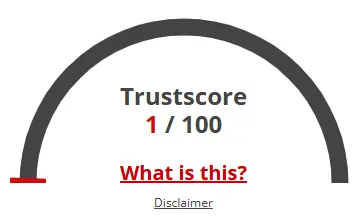
A website’s trust score is an important indicator of its Swaplite icludes low web traffic, negative user feedback, potential phishing risks, undisclosed ownership, unclear hosting details, and weak SSL encryption.
With such a poor trust score, the likelihood of fraud, data breaches, or other security issues is much higher. It is crucial to carefully assess these warning signs before engaging with Swaplite Similar platform.
Positive Highlights
- We found a valid SSL certificate
- DNSFilter labels this site as safe
Negative Highlights
- The Tranco rank (how much traffic) is rather low.
- The age of this site is (very) young.
Frequently Asked Questions About Swaplite
This section answers key questions about Swaplite concerns, and highlights issues related to the platform’s legitimacy.
SwapLite presents itself as a Litecoin arbitrage platform that claims to generate returns through crypto trading.
Investors should exercise caution because its ownership, business model, and claimed returns require independent verification.
SwapLite reportedly promotes returns of up to 4% per day, which would be exceptionally high and difficult to sustain over time.
No clear connection should be assumed between Everstead and SwapLite without reliable evidence confirming such a relationship.
Key risks include high-return claims, limited transparency, cryptocurrency volatility, withdrawal concerns, and insufficiently verified company information
Other Infromation:
WHOIS data : Hidden
Owner : REDACTED FOR PRIVACY
Country: GB
WHOIS Registration Date : 2026-09-06
WHOIS Last Update: 2026-09-07
WHOIS Renew Date: 2027-09-06
Website: Swaplite
Title :Swaplite
Reviews:
There are no reviews yet. Be the first one to write one.