
RAC DeFi Review: What Investors Need to Know About This RWA Platform
This RAC DeFi Review examines the platform’s claims, compensation structure, ownership details, and overall risk profile based on publicly available information. RAC DeFi positions itself as a decentralized real-world asset (RWA) project on the BNB Smart Chain. It promotes USDT deposits, daily returns, multi-level rewards, and tokenized real assets. The review focuses on the compensation plan and the complete absence of verifiable owner profiles so readers can judge the opportunity for themselves. Scams Radar

Table of Contents
Part : 1 Ownership and Background Transparency
No public records identify the founders, CEO, executive team, or legal entity behind RAC DeFi. Domain registration uses privacy protection, so WHOIS data reveals nothing useful. No company registration number, physical address, board members, or verified LinkedIn profiles appear in open sources.
Independent checks found no evidence linking any named individuals to past MLM companies, Ponzi schemes, or criminal cases. At the same time, the total lack of identifiable leadership means investors cannot confirm who controls deposits, treasury wallets, or smart contracts. This opacity is a core concern for any platform handling crypto funds.

1.1 How the Compensation Plan Works
The platform invites users to deposit USDT with a stated minimum of 100 USDT and no upper limit. Key features described in marketing materials include:
- A 12-day contract cycle paying 1.33 percent daily.
- Total earnings capped at three times the original deposit (deposit income plus referral and rank income).
- Direct referral bonuses of 5 percent every 10 days, reaching 15 percent monthly under upgrade conditions.
- Multi-level income stretching up to 20 levels.
- Rank rewards paid in RAC tokens.
- Automatic purchase of RAC tokens equal to 5 percent of each new deposit.
- ROI-on-ROI deductions and forced upgrades to keep referral payouts active.
Simple math on the base rate shows 1.33 percent × 12 days equals roughly 15.96 percent per cycle. Spread across a year this produces an annualized figure near 485 percent before compounding. Daily compounding pushes the theoretical number far higher. Even with the 3× cap, the structure still requires constant new deposits to cover earlier participants’ returns, referral commissions, and token buybacks.
1.2 Why the Numbers Do Not Hold Up
Legitimate real-world asset yields stay far lower. Bank savings and high-yield accounts typically offer 4–5 percent APY. Rental real estate plus appreciation usually ranges between 5 and 12 percent annually in most markets. Established DeFi lending and liquidity pools on major protocols commonly deliver single-digit to mid-teens returns, often with smart-contract and market risk attached.
No documented portfolio of tokenized real estate, gold, or other collateral produces a steady 1.33 percent daily after costs and fees. When payouts exceed any realistic external yield, the only remaining source of funds is new investor capital—an arrangement that collapses once recruitment slows.
Part : 2 Traffic, Security, and Public Footprint
Traffic tools show negligible organic visits. Social-media searches for the project name or domain turn up almost no independent discussion. No audited smart-contract addresses, CertiK or PeckShield reports, or open-source code repositories were located. The site relies on marketing language, countdown timers, and name-dropping of well-known institutions without any proven affiliation.
Payment is crypto-only (mainly USDT). Transactions are irreversible. Customer-support channels are not clearly documented. These patterns match many short-lived high-APY schemes that pay early users from later deposits and then encounter withdrawal problems.
2.1 Comparison With Realistic Alternatives
Investment Type | Typical Annual Return | Risk Level |
High-yield savings | 4–5 % | Low |
S&P 500 historical average | ~10 % | Medium |
Rental real estate | 5–12 % | Medium |
Legitimate stablecoin lending | 3–15 % | Medium–High |
RAC DeFi advertised cycle | ~485 %+ | Extreme |
The gap between promised figures and verifiable market returns is the clearest warning signal.
2.2 Practical Takeaways for Readers
Investors looking at RWA DeFi, tokenized real estate, or on-chain collateral should demand three things before sending funds: identifiable leadership, audited proof of underlying assets, and a published compensation plan that does not rely on endless recruitment. RAC DeFi currently supplies none of these.
Related searches that help with due diligence include “is RAC DeFi legit,” “RAC DeFi risks,” “RWA lending platform,” “tokenized property collateral,” and “DeFi yield from real-world assets.” Always cross-check contract addresses on a blockchain explorer, review domain age and trust scores, and compare claimed yields against regulated alternatives.
Final Assessment
This RAC DeFi Review finds a platform that markets high fixed returns, multi-level rewards, and real-world asset backing while providing almost no verifiable ownership details or sustainable math. The combination of anonymous control, extreme daily rates, and heavy referral incentives creates elevated risk of total loss.
Prospective participants are advised to treat any capital sent as money they are prepared to lose entirely. Prefer platforms that publish audited financials, named executives, and realistic yield ranges. Conduct independent research, verify every claim on-chain, and never rely solely on marketing pages or affiliate presentations.
RAC DeFi Review
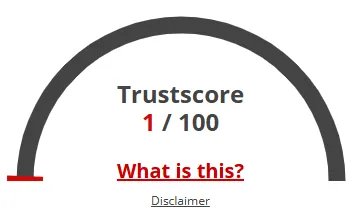
A website’s trust score is an important indicator of its reliability RAC DeFi includes low web traffic, negative user feedback, potential phishing risks, undisclosed ownership, unclear hosting details, and weak SSL encryption.
With such a poor trust score, the likelihood of fraud, data breaches, or other security issues is much higher. It is crucial to carefully assess these warning signs before engaging with a RAC DeFi Similar platform.
Positive Highlights
- We found a valid SSL certificate
- DNSFilter labels this site as safe
Negative Highlights
- The Tranco rank (how much traffic) is rather low.
- The age of this site is (very) young.
Frequently Asked Questions About RAC DeFi Review
This section answers key questions about RAC DeFi clarifies points, addresses concerns, and highlights issues related to the platform’s legitimacy.
RAC DeFi claims to offer crypto-based investment opportunities. Research carefully before investing.
Check its transparency, ownership, and regulatory status before investing.
Watch for unrealistic returns, hidden ownership, and unclear business operations.
Compare both platforms based on transparency, risks, and sustainability.
Only invest after doing thorough research and understanding the risks.
Other Infromation:
WHOIS Registration Date: 2026-07-28
WHOIS Last Update: 2026-07-28
WHOIS Renew Date: 2027-07-28
Website: RAC DeFi
Reviews:
There are no reviews yet. Be the first one to write one.