Washington DFI Issues Alert on BG Wealth Sharing and DSJ Exchange

On April 10, 2026, the Washington Department of Financial Institutions (DFI) issued a fraud warning against BG Wealth Sharing and DSJ Exchange (DSJEX), stating that both “may be fraudulent,” per. Investors have reported being unable to withdraw funds, with only limited small withdrawals allowed in some cases — a classic tactic used in crypto scams to build false trust and recruit more victims, per.
BG Wealth Sharing: A Typical “Click-a-Button” MLM Ponzi
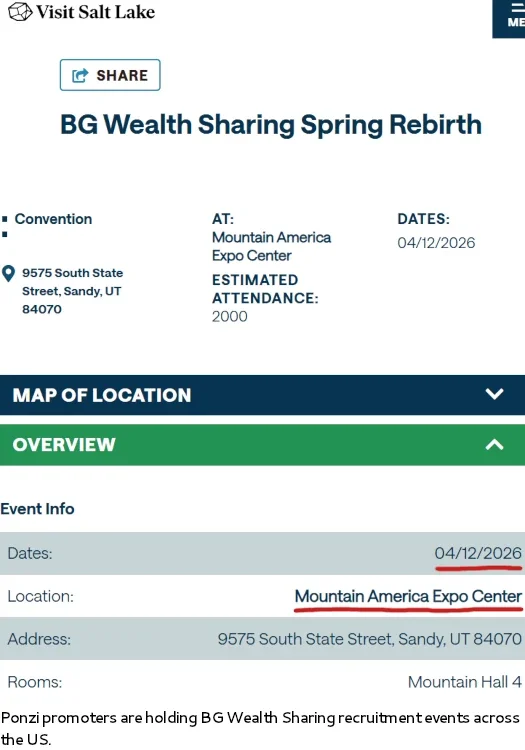
BG Wealth Sharing operates as an MLM “click a button” app Ponzi run by Chinese scammers, a model documented extensively since 2021. The platform promises high returns through simple daily tasks or button clicks, but in reality functions as a pyramid scheme where new investor money pays earlier participants. DSJ Exchange serves as the attached fake trading platform, creating the illusion of legitimate investment activity.
The operators falsely claim the companies are based in the U.S. and registered with the SEC. However, DFI debunked these claims:
- Both entities are incorporated in Colorado, but the addresses provided are not legitimate business locations — one is a generic PostNet mailbox and the other a temporary office rental space.
- The claimed founding dates do not match the actual incorporation filings.
- BG Wealth filed a partial Form ADV and obtained Exempt Reporting Adviser (ERA) status, while DSJ filed a Form D claiming an exemption. Neither constitutes actual SEC registration or oversight. ERAs are not regularly examined, and Form D filings are not validated by the SEC.
Communication Red Flags and Global Warnings
Scammers primarily communicate with victims through unregulated chat platforms such as WhatsApp, Telegram, Signal, and Bonchat — another major red flag, as legitimate investment firms rarely use these channels exclusively.
Washington DFI joins a growing list of regulators that have issued warnings against BG Wealth Sharing, including Australia, Tonga, the UK, New Zealand, the Philippines, Utah, Saskatchewan, Samoa, and the Bahamas.
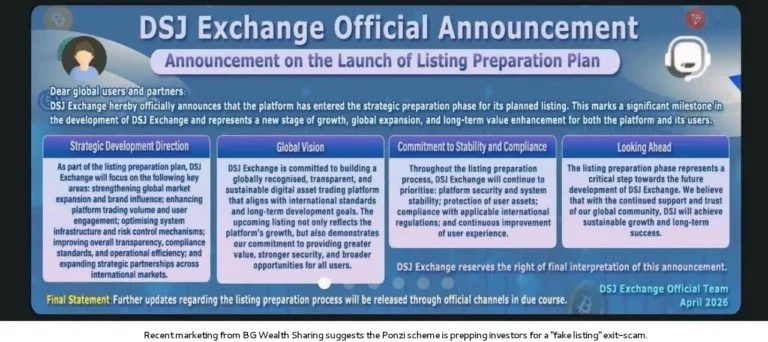
Recent marketing materials suggest the operation may be preparing a “fake listing” exit-scam, where investors are asked for additional “regulatory” or “tax” fees before the platform disappears with the funds.
Current Domains and Ongoing Activity
The scam frequently rotates domains as registrars flag fraudulent sites. As of April 2026, active domains include:
- dsj679.com (privately registered April 2, 2026)
- dsj610.cc (privately registered April 2, 2026)
- tin22.com (privately registered November 12, 2025)
These domains are expected to change soon as more are flagged.
Investor Advice
Investors should avoid BG Wealth Sharing and DSJ Exchange entirely. Verify any crypto or investment platform through official regulators such as the SEC, CFTC, or state departments like Washington DFI. Do not send money or personal information through chat apps for investment opportunities. If you have already invested, report the activity to your local securities regulator and consider consulting a lawyer specializing in fraud recovery.
Bitcoin (BTC) and the broader crypto market remain unaffected by this specific scam, but such schemes damage overall trust in digital assets.