
Neural Bet Review 2026: Ownership Details, Compensation Plan, Founders Background and Investment Risks
This Neural Bet Review examines the platform’s claimed prediction-market arbitrage model, company ownership, founder backgrounds, multi-level compensation structure, advertised returns, and key risk factors. Readers seeking clear information on Neural Bet can use this overview to understand how the service works and what independent checks still remain incomplete.
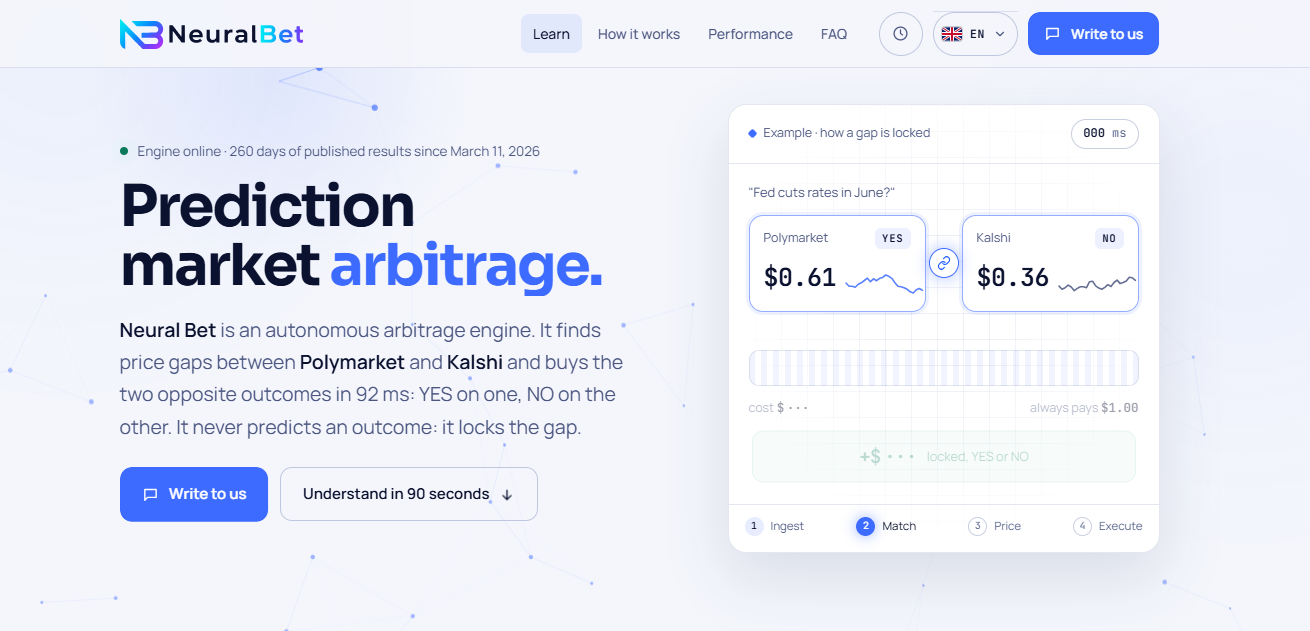
Neural Bet positions itself as an automated system that looks for price gaps between Polymarket and Kalshi. It buys opposite outcomes (YES on one venue and NO on the other) when the combined cost sits below the $1 settlement value. The operator pools customer crypto deposits and shares net trading gains according to a stated split. The business runs mainly through a Telegram mini-app and identifies Winastar Consulting FZ LLC (RAKEZ registration 46000346) in Ras Al Khaimah, UAE, as its operating company. Domain registration occurred on 25 September 2026.Scams Radar
Part : 1 Company Ownership and Legal Identity
Table of Contents
Winastar Consulting FZ LLC is the named legal entity. A free-zone commercial registration supplies a corporate identity and an address in the Compass Building, Al Hamra Industrial Zone. It does not automatically grant permission to manage pooled investment capital or offer regulated financial services. The site itself states that the service is not a licensed financial institution and that investors can lose their entire deposit.
No complete public shareholder register or ultimate-beneficial-ownership filing was located in the reviewed materials. Prospective participants should verify the exact licensed activities directly with RAKEZ and relevant regulators before treating the registration as full authorization.
1.1 Founders Profiles and Business History
Two individuals appear as co-founders.
Pierre Lavarague is presented as a co-founder with a background in cryptocurrency and Web3. Company materials list earlier roles linked to Savitar Exchange, Pronoo (an AI and sports-related software project), Trust Wallet business development, Morpho advisory work, and Bitpanda Web3 activities. These remain biographical claims rather than independently audited employment records. No verified prior MLM or Ponzi conviction appears in the examined sources.
Lucas Alain Sébastien Caporgno is described as founder of Winastar and a prediction-market specialist. French corporate records show him as director of VZLC, which traded under the name WINASTAR PRONOS (SIREN 903 189 231, established September 2021 in Aix-en-Provence as a SASU with €100 capital and consulting activity). A UK company, LCBA INVESTMENT LTD, listed a Lucas Caporgno as director and was dissolved by compulsory strike-off in December 2024. These records establish prior business activity under the Winastar name but do not prove misconduct. Claims of managing a $90 million fund lack independent audit confirmation in the available material.
BehindMLM’s November 2025 review noted no clear earlier MLM history for either founder. Absence of identified records is not proof that none exist; further primary-source checks remain advisable.
1.2 How the Claimed Arbitrage Model Works
Prediction markets let participants buy contracts that pay $1 if an event occurs and $0 if it does not. Neural Bet’s engine is said to scan for moments when the cost of YES on one platform plus NO on the other totals less than $1. A simple illustration:
- YES purchased at $0.48
- NO purchased at $0.49
- Combined cost $0.97
- Settlement $1.00
- Gross difference roughly 3 % before fees and slippage
Both legs must fill, contracts must settle under matching rules, and liquidity must exist. Partial fills leave directional exposure. The company lists execution risks, network issues, and settlement differences among the factors that can reduce or eliminate the margin. Advertised infrastructure figures (sub-100 ms windows, multi-million-dollar capacity) are operator statements, not third-party verified statistics.
Part : 2 Neural Bet Compensation Plan and Profit Sharing
Profit distribution is one of the clearest publicly described elements. After execution costs, net trading gains are allocated as follows:
Recipient | Share of Net Profit |
Client / Investor | 50 % |
Business introducers | 35 % |
Company | 15 % |
The 35 % introducer pool funds the referral program. Earlier reporting described a ten-level unilevel structure distributing that pool roughly as 5 % on each of the first five levels and 2 % on levels six through ten. Current public materials confirm the overall 50/35/15 split but do not publish a complete level-by-level schedule with qualification rules. Members are directed to obtain terms from their introducer.
No verified binary or matrix plan appears in the reviewed documents. The model is therefore best described as a profit-sharing arrangement with a multi-level unilevel referral component rather than a classic binary or forced-matrix scheme.
Minimum deposits have been reported at different levels across materials (earlier figures near $100, later official guidance at $3,000). Crypto deposits (USDT and USDC on several networks) carry no platform fee beyond network costs. Card payments involve a 3 % charge and, in some descriptions, purchase of an AI training course from a related entity followed by a 30-day withdrawal restriction. Withdrawals are processed after open positions close and are subject to a low minimum.
2.1 Advertised Performance and Sustainability Questions
Operator dashboards have shown cumulative client returns near 146 % over roughly 258–259 days, with positive-day rates above 98 % and very small reported drawdowns. Average daily figures around 0.5–0.6 % appear in some snapshots. These numbers are company-generated and not independently audited.
Simple compounding illustrations demonstrate why the scale of claims requires substantial external profit:
- At a steady 10 % monthly client return on $50 million of capital, clients would need $5 million monthly. Under a 50 % client share the operation must generate $10 million net trading profit each month.
- Higher promotional ranges of 13–20 % monthly raise the required external profit still further.
Prediction-market spreads are real but thin, short-lived, and competed for by professional participants. Liquidity constraints, fees, slippage, and partial fills compress net yields as capital grows. The combination of high advertised client returns plus a large introducer allocation means the model needs consistent, verifiable trading profit; new deposits alone cannot sustainably fund ongoing distributions.
2.2 Custody, Payments and Operational Points
Customer funds are pooled in a multi-signature vault associated with Winastar. Signatory identities, number of required signatures, and legal segregation of assets are not fully transparent in public materials. Investors cannot independently confirm that displayed balances equal withdrawable cash at any moment.
Support is handled primarily through Telegram (@neuralbetsupport). The site warns against impersonation accounts. Website security includes standard HTTPS; reputation scanners have assigned low trust scores, citing domain age, privacy-protected WHOIS, and high-risk financial content.
2.3 Key Considerations for Readers
- Extraordinary claimed consistency and returns remain operator-reported.
- Pooled custody places reliance on the operator’s controls and solvency.
- Referral incentives create a financial reason for promoters to recruit.
- Regulatory status is limited to commercial free-zone registration; the platform states it is not a regulated financial service.
- Domain age is recent relative to the start date of published performance history.
Independent verification would include exchange account statements, trade IDs, wallet reconciliations, audited profit-and-loss figures, and a complete current compensation agreement.
Conclusion
This Neural Bet Review shows a clearly described arbitrage concept paired with a transparent 50/35/15 profit split and a multi-level referral component. Founder backgrounds include prior consulting and Web3 activity, and a UAE free-zone entity is named. At the same time, independently audited trading records, full custody transparency, and regulatory authorization for the investment activity remain incomplete. Prospective participants should treat published performance figures as company statements, verify every claim with primary documents, and never commit capital they cannot afford to lose. Related searches that may help further research include Neural Bet arbitrage mechanics, Polymarket versus Kalshi spreads, and multi-signature vault risks in crypto platforms.
Neural Bet Review
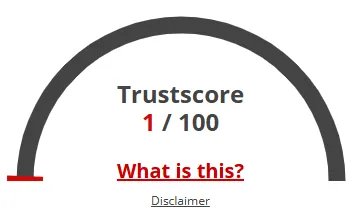
A website’s trust score is an important indicator of its Neural Bet icludes low web traffic, negative user feedback, potential phishing risks, undisclosed ownership, unclear hosting details, and weak SSL encryption.
With such a poor trust score, the likelihood of fraud, data breaches, or other security issues is much higher. It is crucial to carefully assess these warning signs before engaging with Neural Bet Similar platform.
Positive Highlights
- We found a valid SSL certificate
- DNSFilter labels this site as safe
Negative Highlights
- The Tranco rank (how much traffic) is rather low.
- The age of this site is (very) young.
Frequently Asked Questions About Neural Bet
This section answers key questions about Neural Bet concerns, and highlights issues related to the platform’s legitimacy.
Neural Bet has an identified operating company, but its legitimacy and trading claims remain unverified.
Neural Bet claims to generate profits through automated arbitrage between prediction markets.
Neural Bet reportedly uses a ten-level unilevel referral plan. Binary and matrix plans remain unverified.
Major risks include unverified returns, pooled funds, withdrawal restrictions, and regulatory uncertainty.
An Everstead Review comparison highlights the importance of verified returns, transparent ownership, and investor protection.
Other Infromation:
WHOIS data : Hidden
Owner : REDACTED FOR PRIVACY
Country:US
WHOIS Registration Date : 2026-09-25
WHOIS Last Update: 2026-09-25
WHOIS Renew Date: 2027-09-25
Website: Neural Bet
Title : Neural Bet
Reviews:
There are no reviews yet. Be the first one to write one.