ZoomexReview: Ownership Background, Affiliate Compensation Plan, and Full Platform Assessment for 2026
This Zoomex Review examines the crypto exchange launched in 2021. It covers ownership details, the real compensation structure, security claims, user feedback, and key risks in plain language. Zoomex operates as a derivatives-focused platform with perpetual futures, some spot trading, copy trading, and earn products. It reports over three million users across more than 35 countries. The platform is not a pure exit scam, yet it sits in a high-risk offshore category common to many mid-tier crypto venues.ScamsRadar
Part : 1Ownership and Corporate Structure
Table of Contents
Zoomex is a brand operated by Octochain Fintech Limited. Materials point to a Cayman Islands structure with references to Vistra Cayman Trust Limited. Earlier notes also mention Seychelles registration under Octochain Fintech Limited. Domain and app listings confirm this entity as the operator.
The most consistently named public figure is Jerry X (also referenced as Jay Hsu or Jerry Hsu). He appears as co-founder and CEO in industry databases and company statements dating to around October 2021. Other names surface in founder listings: Amos Z, Jack M (sometimes listed as Jack Ma—unrelated to Alibaba’s founder), Pony Meyer, Ju Won Choi, Reiko Fujita, Solomon Li, and Nelson Tuo. These associations come mainly from professional profiles and databases. Exact shareholdings and beneficial ownership remain hard to verify independently. Full executive team details and audited financials are limited. This opacity is a frequent criticism.
No reliable public records establish criminal convictions or prior Ponzi operations for the named individuals. The structure is typical of offshore crypto platforms: real operations exist, yet ultimate control is not fully transparent.
1.1 Licenses, Regulation, and Documented Warnings
Zoomex cites Money Services Business registrations with FINTRAC (Canada), FinCEN (United States), and AUSTRAC (Australia). It also references St. Lucia IBC and Mwali (Comoros) MISA credentials, plus Hacken security audits. These registrations support AML compliance but do not equal full exchange or derivatives licenses from Tier-1 regulators such as the SEC, FCA, or ASIC.
Spain’s CNMV issued a warning in February 2023 that Zoomex / Octochain Fintech Limited was not authorized for investment services. France’s AMF added it to a blacklist in June 2024. Norway maintained a related investor warning. Service is restricted in the United States, European Union, Singapore, Hong Kong, mainland China, and several other jurisdictions. Users outside restricted areas still face limited legal recourse if disputes arise.
1.2 Compensation Plan: Affiliate and Referral Structure, Not Traditional MLM
Zoomex runs a formal affiliate (Global Partner / ZAP) program and separate referral campaigns. Official documentation ties commissions to eligible trading fees generated by referred clients, not to deposits. This is a conventional revenue-share model.
Basic flow:
Affiliate shares a tracked link → Client registers and trades → Platform collects fees → Affiliate receives a percentage of qualifying fees (after discounts, market-maker costs, and bonuses).
Commission ratios are variable and performance-based. Affiliates can face downgrades if they fail to deliver minimum client numbers and trading volume (examples in materials include thresholds around 10 clients and 50 BTC monthly volume in a quarter). Referral campaigns offer smaller rewards—such as USDT coupons for deposits and volume milestones—separate from the affiliate program.
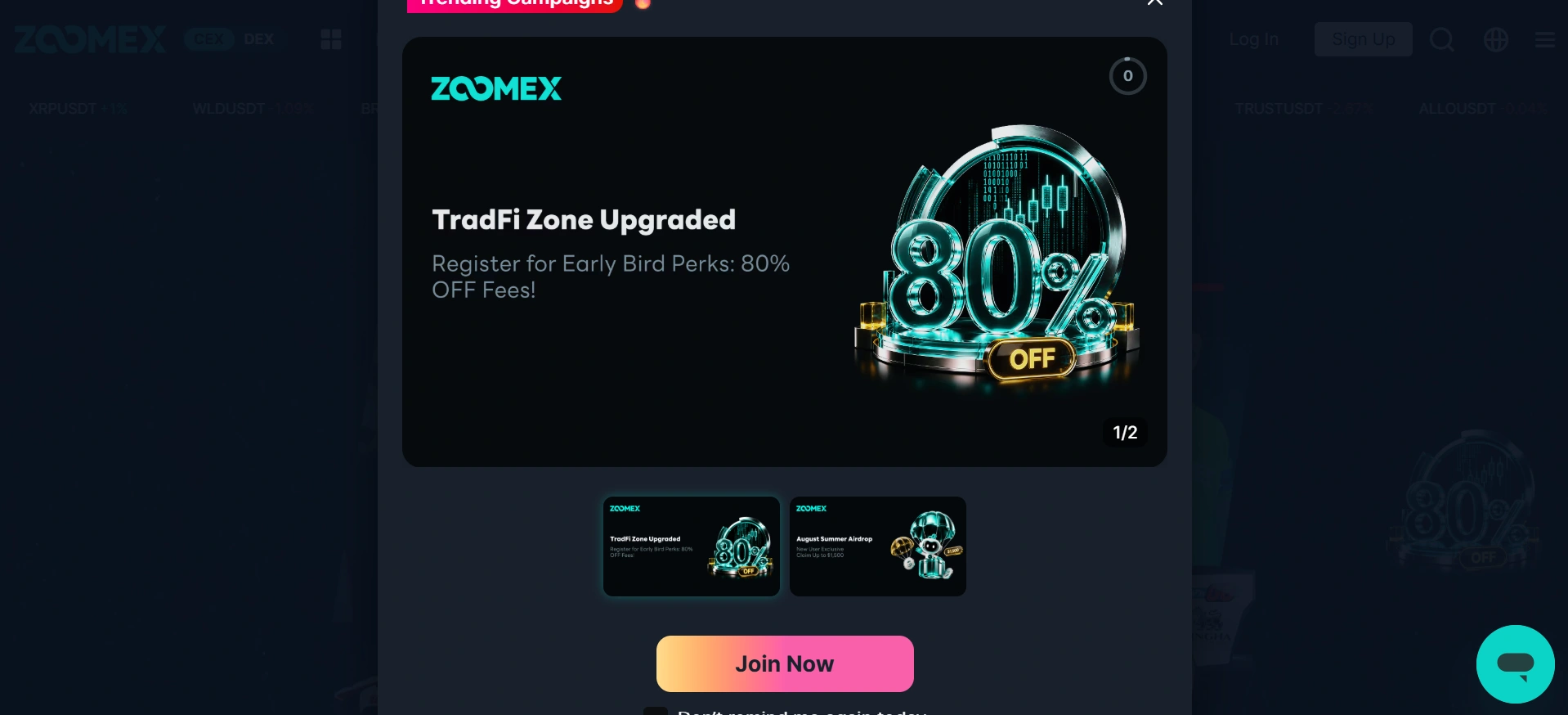
No official evidence supports a binary, unilevel, or matrix multi-level marketing plan with multi-generation downline commissions. Promoters may organize teams informally, but the company pays on direct referred trading activity. High promotional figures (welcome rewards up to 14,000 USDT, short-term APYs of 50 percent or headline 666 percent for new users) are capped, time-limited, task-based, and often non-withdrawable as pure cash. They function as marketing incentives, not guaranteed investment returns.
Part : 2 Simple mathematical illustration of affiliate economics
Assume a 0.1 percent fee and a 40 percent affiliate share: effective rate = 0.04 percent of volume.
To earn 1,000 USDT requires roughly 2.5 million USDT in qualifying volume.
Deposits alone do not generate commissions. Trading volume is turnover; fees are the actual revenue slice.
High fixed-percentage claims (for example, 10–20 percent monthly on deposits) appear only in third-party promoter language, not in official terms. Such rates compound to hundreds or thousands of percent annually and require verifiable economic sources that ordinary trading fees cannot sustain at scale.
2.1 Comparison of realistic returns (illustrative annual ranges)
Asset Class | Typical Range | Risk Notes |
Bank savings / high-yield | 1–5% | Low, often insured |
Real estate (net) | 5–12% | Illiquidity, costs |
Regulated crypto staking | 3–15% | Smart-contract & market risk |
Zoomex promotional APYs | Variable, capped | Short-term, conditional incentives |
High-leverage futures | Unlimited upside | Near-certain loss risk for most retail |
2.2 Security, Proof of Reserves, and User Experience
Claims include multi-signature cold/hot wallet separation, 2FA, withdrawal whitelisting, and Hacken audits with bug-bounty programs. Proof-of-reserves snapshots linked to public data have shown roughly 20–45 million USD across major assets. No large successful hacks with customer fund losses have been widely reported since launch. Audits have identified and partially remediated critical and high findings in past reports.
Trustpilot scores hover in the low-to-mid 2 range from dozens of reviews. Common complaints involve delayed or blocked withdrawals, account freezes after deposits, unexpected liquidations, and slow support. The company frequently attributes issues to phishing or clone sites and urges users to verify the official domain. Positive comments mention interface speed, low fees, and feature set. Scamadviser rates the domain as technically low-risk while flagging the inherent dangers of crypto services.
Deposits are mostly crypto (USDT/USDC common). Fiat options exist via partners in some regions and may carry temporary holds. Support is advertised as 24/7 multilingual; real-world results are mixed.
Practical Recommendations
Treat the platform as a high-risk trading venue, not a savings product or guaranteed-yield vehicle. Start with small test amounts. Enable every security feature. Withdraw regularly. Never send funds to personal wallets of promoters. Verify the official domain every time. Prefer fully regulated alternatives (Coinbase, Kraken, or equivalent licensed venues) when capital preservation matters most. High-leverage products and promotional APYs suit only those who fully understand liquidation mechanics and can absorb total loss.
ZoomexReview summary: the exchange shows evidence of real operations and a fee-based affiliate model, yet regulatory warnings, ownership gaps, mixed withdrawal experiences, and marketing intensity place it firmly in the elevated-risk category. Independent verification of current terms, fees, and restrictions remains essential before any deposit.
ZoomexAI Review
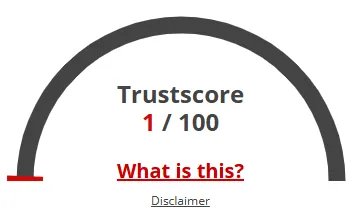
A website’s trust score is an important indicator of its ZoomexAI includes low web traffic, negative user feedback, potential phishing risks, undisclosed ownership, unclear hosting details, and weak SSL encryption.
With such a poor trust score, the likelihood of fraud, data breaches, or other security issues is much higher. It is crucial to carefully assess these warning signs before engaging with a ZoomexAI Similar platform.
Positive Highlights
- We found a valid SSL certificate
- DNSFilter labels this site as safe
Negative Highlights
- The Tranco rank (how much traffic) is rather low.
- The age of this site is (very) young.
Frequently Asked Questions About ZoomexAI
This section answers key questions about ZoomexAI concerns, and highlights issues related to the platform’s legitimacy.
Zoomex has several transparency and investment-related risks to consider.
Is Zoomex regulated and safe for investors?
Check its regulation, ownership, security, and withdrawal policies first.
Risks include volatility, unclear operations, withdrawal issues, and high-return claims.
Everstead Review is separate and does not verify Zoomex’s legitimacy.
Other Infromation:
WHOIS data : Hidden
Owner : REDACTED FOR PRIVACY
Country:NL
WHOIS Registration Date :1999-06-23
WHOIS Last Update:2022-12-15
WHOIS Renew Date: 2025-06-23
Website: ZoomexAI
Title : ZoomexAI
Reviews:
There are no reviews yet. Be the first one to write one.