
Bitraze Review: Ownership Gaps, Compensation Details, and Investment Risk Check
This Bitraze review examines ownership transparency, the compensation structure, and overall risk for anyone considering the platform. Bitraze positions itself as an AI-driven blockchain project supporting decentralized finance, commerce, logistics, and a Web3 ecosystem. It promotes the BTZAI token on the BNB Smart Chain as a BEP-20 asset with claims of staking rewards, token utility, and a long-term roadmap. Public records show a young domain, hidden ownership, and no verified performance data. This analysis draws only from available domain records, scanner reports, and promotional patterns to help readers weigh the facts. Scam Radar
Table of Contents
Part : 1 Ownership and Background Transparency
Domain records list registration on 6 August 2025 through Namecheap. Privacy protection via Withheld for Privacy ehf in Reykjavik fully hides the registrant. Hosting sits on Namecheap shared servers in the Los Angeles area. No company name, directors, physical address, or regulatory license appears in public filings or on the site itself.
No LinkedIn profiles, media interviews, or corporate databases link any individual to the project. No verifiable team bios exist. Claims of a corporate AI blockchain platform remain unsupported by audited records or public code repositories. Similar names such as BitradeX or Bitrace.io refer to unrelated entities and should not be confused with this platform.
The absence of identifiable owners means investors cannot confirm who controls funds or who bears legal responsibility. This lack of disclosure stands as a primary transparency concern for any platform accepting deposits.

1.1 Compensation Plan and Referral Structure
No official compensation plan PDF or detailed rank rules appear on the platform. Promotional materials shared by affiliates describe referral rewards, team commissions, leadership bonuses, VIP levels, and rank advancement. Higher ranks reportedly need personal deposits, multiple direct referrals, and qualified team legs with volume targets.
Evidence does not confirm a binary plan with left-right pairing or a matrix with forced spillover. Descriptions more closely resemble unilevel elements: direct referral commissions, multi-level team overrides, and differential income. Token purchases and package upgrades feature in many presentations. Staking rewards and daily or fixed-term investment products are also mentioned in marketing, yet no audited yield figures or smart-contract verification support those claims.
Because the plan remains unpublished, participants cannot independently calculate exact commission percentages, qualification thresholds, or matching bonuses. This opacity complicates any assessment of payout sustainability.
1.2 Mathematical Reality of High Returns
Promotional language around AI trading, arbitrage, and automated strategies often implies steady high yields. Typical claims in similar projects range from fractions of a percent daily to double-digit weekly rates. The compounding math quickly exceeds real-world benchmarks.
Consider a modest 0.5 percent daily compound return on a $1,000 deposit:
After 365 days the balance reaches roughly $6,150 (about 515 percent gain).
After two years it approaches $37,800.
A 1 percent daily rate turns $1,000 into more than $37,000 in one year (over 3,600 percent APY). Even a 2 percent weekly rate grows $1,000 to about $2,800 in a year.
Compare those figures with established asset classes:
Asset Class | Typical Annual Return |
Bank savings / high-yield | 3–8 % |
Government bonds | 4–8 % |
Rental real estate (net) | 5–12 % |
Global stock market average | ~10 % |
Professional hedge funds | 10–20 % |
Major crypto staking | 2–15 % |
No regulated trading firm or DeFi protocol consistently delivers hundreds of percent annually without taking extreme leverage or temporary incentive risk. When referral commissions further reduce the capital available for trading, the required external profit rises even higher. Sustained payouts under those conditions depend on continuous new deposits rather than verified trading alpha.
Part : 2 Security, Traffic, and Public Footprint
Scanners report a valid Sectigo SSL certificate and no active malware blacklists. Gridinsoft scores hover in the 68–72 range with a “trust but verify” note that cites the young domain and privacy shield. Other automated tools assign lower trust ratings, sometimes below 15/100, flagging anonymity and limited history.
Traffic data remain minimal. Independent discussion threads and review volume stay near zero. Social promotion appears mainly through affiliate channels rather than verified corporate accounts. Claims of celebrity endorsements circulate in some networks but lack confirmation from primary sources.
No whitepaper with technical depth, audited smart contracts, or on-chain activity metrics has been located. The 10-year roadmap lists broad milestones without measurable deliverables or public development evidence.
2.1 Key Risk Indicators
- Fully private domain ownership with no verifiable executives
- No published compensation plan or audited trading results
- Heavy reliance on referral and rank advancement language
- ROI claims that exceed long-term returns of every major asset class
- Extremely limited independent reviews and traffic
- Irreversible crypto deposits with unconfirmed withdrawal processes
These points do not constitute legal proof of misconduct. They do establish that transparency remains insufficient for confident capital allocation.
2.2 Practical Due-Diligence Steps
Prospective participants should request the legal entity name and jurisdiction, director identities, any applicable securities or money-services licenses, independently audited financial statements, and proof-of-reserves linked to trading activity. Blockchain explorers can reveal token holder concentration and transfer patterns if the BTZAI contract is live. Independent forums and historical domain snapshots provide additional context.
Conclusion
This Bitraze review finds consistent gaps in ownership disclosure, compensation documentation, and performance verification. The platform markets an ambitious AI and Web3 vision built around the BTZAI token, yet public records supply no confirmed team, no audited results, and no transparent payout rules. High projected returns conflict with mathematical limits observed across traditional and crypto markets. Until verifiable ownership, licenses, and audited trading evidence appear, the investment risk stays elevated. Readers should treat any decision as speculative and limit exposure to capital they can fully afford to lose. Always perform independent verification before transferring funds.
Bitraze Review
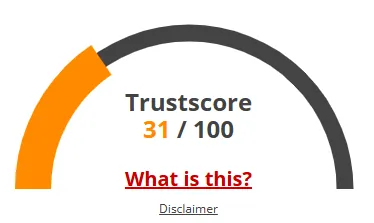
A website’s trust score is an important indicator of its reliability Bitraze includes low web traffic, negative user feedback, potential phishing risks, undisclosed ownership, unclear hosting details, and weak SSL encryption.
With such a poor trust score, the likelihood of fraud, data breaches, or other security issues is much higher. It is crucial to carefully assess these warning signs before engaging with a Bitraze Similar platform.
Positive Highlights
- We found a valid SSL certificate
- DNSFilter labels this site as safe
Negative Highlights
- The Tranco rank (how much traffic) is rather low.
- The age of this site is (very) young.
Frequently Asked Questions About Bitraze Review
This section answers key questions about Bitraze clarifies points, addresses concerns, and highlights issues related to the platform’s legitimacy.
Bitraze claims to offer crypto-based investment opportunities.
Verify its transparency, compliance, and revenue sources first.
High ROI claims, limited transparency, and unclear operations.
Returns are not guaranteed and carry significant risk.
Compare transparency, risks, and business models before investing.
Other Infromation:
WHOIS Registration Date: 2025-08-06
WHOIS Last Update: 2025-08-11
WHOIS Renew Date: 2026-08-06
Website: Bitraze
Reviews:
There are no reviews yet. Be the first one to write one.