
TroveNFT.net Review: Ownership Details, Compensation Plan and Full Risk Check
This trovenft.net review looks at ownership, the compensation plan, and overall safety for anyone considering the platform. The site presents itself as an NFT investment option with smart trading tools and referral rewards. Public records available in late July 2026 show a young domain, hidden ownership, and no clear proof of how returns are generated. The goal here is to lay out the facts in plain language so readers can decide for themselves. Scams Radar

Table of Contents
Part : 1 Domain Age, Ownership and Company Background
The domain was registered on May 16, 2026 through Dynadot Inc. It is set to expire one year later. WHOIS records use full privacy protection, so no real owner name, organization, or contact details appear beyond the registrar’s abuse channels. Hosting runs on Amazon CloudFront with basic domain-validated SSL. Traffic ranks near zero on major trackers.
No company registration number, physical address, or beneficial owner can be confirmed in open records. Claims of a Tempe, Arizona base do not match independent checks. No CEO, founder, or directors have verified public profiles. LinkedIn and corporate databases return nothing solid. This means the people behind the platform stay anonymous.
Ownership red flags include:
- Privacy-shielded registration less than three months old
- No verified legal entity
- No confirmed headquarters
- No published directors or officers
Anonymous management limits accountability when money is involved.

1.1 What the Platform Claims and the Compensation Plan
Marketing materials describe smart NFT algorithm trading, AI-powered activity, asset custody, a risk fund, and a “Dual Income” model. Referral commissions form a clear part of the pitch. Promoters stress inviting friends, building teams, daily earnings, leadership ranks, and passive income.
No official compensation document appears on public pages or in open filings. There is no published list of commission rates, rank requirements, or bonus rules. Checks for standard MLM structures show:
- Binary plan (left/right legs, pairing bonuses): not verified
- Matrix plan (fixed width and depth): not verified
- Unilevel-style referrals: possible because personal invites and multi-level talk appear in promotions, yet depth, percentages, and caps stay unpublished
Without an official plan, investors cannot calculate exact payouts or see how commissions are funded. Referral talk often outweighs discussion of actual NFT sales or trading volume. That pattern shifts attention toward recruitment rather than product results.
1.2 Mathematical Reality of the ROI Claims
Some reports mention daily returns in the 4–7 percent range or monthly figures near 30 percent. Other promotions float 5–10 percent weekly or monthly numbers. Simple compound math shows why these numbers cannot last.
Start with $1,000 at 5 percent daily:
- After 30 days the balance reaches roughly $4,322
- After one year the same money would exceed $54 million
Even a lower 10 percent monthly claim turns $10,000 into more than $31,000 in twelve months. Real-world benchmarks look very different:
Investment Type | Typical Annual Return | Notes |
High-yield savings / Treasuries | 1–5 % | Near risk-free |
Real estate / REITs | 4–8 % | After costs and taxes |
Blue-chip stocks (long-term) | 7–10 % | Historical average |
Legitimate crypto staking | 2–15 % | Variable and not guaranteed |
Claimed platform figures | Hundreds to thousands of % | Requires constant new deposits |
Any business that pays out more than it earns from real trading or sales must fill the gap with new investor money. When recruitment slows, payouts stop. That is the classic structure of an unsustainable model. No audited trading volume, marketplace revenue, or on-chain treasury proof has been located to support the promised yields.
Part : 2 Trust Scores, Traffic and Public Perception
Independent checkers give mixed but mostly cautious results. Scamadviser lists a trust score of 0 and labels the site likely unsafe because of its age and low traffic. Gridinsoft scores it 60/100 and advises verification. Other scanners show no widespread malware, yet the absence of blacklists does not equal safety for an investment site. Traffic data remains near zero. Public discussion on major review sites and forums is almost nonexistent.
Social media activity consists mainly of temporary promotional accounts rather than official verified channels. Similar-sounding NFT projects have faced rug-pull and withdrawal complaints in recent years. Name overlap alone proves nothing, yet the pattern of short-lived domains with high-return claims is familiar.
2.1 Security, Payments and Support Notes
Basic SSL encryption is present. That only protects data in transit; it does not prove the business is legitimate. Customer support channels beyond registrar abuse contacts are hard to verify. Payment methods on comparable platforms lean heavily toward crypto, which is irreversible once sent. User reports on similar sites often describe easy deposits followed by delayed or blocked withdrawals. No independent audit of smart contracts or proof-of-reserves appears in open sources.
2.2 Risk Summary Table
Risk Factor | Level | Reason |
Ownership transparency | High | Privacy-protected, no public team |
Domain age | High | Registered May 2026 |
Compensation plan clarity | High | No official document published |
Audited financials | High | None located |
ROI sustainability | High | Math exceeds real market returns |
Public reputation & traffic | High | Near-zero independent discussion |
Previous MLM or Ponzi links | None verified | Operators remain unidentified |
Final Assessment and Practical Advice
The platform shows multiple classic warning signs: a brand-new domain, hidden ownership, unpublished compensation details, and return claims that exceed any realistic NFT or trading business. No verified executives, audited statements, or on-chain proof of profits have been found. Referral marketing is visible, yet the exact structure stays opaque.
Readers should treat the opportunity as high-risk. Do not deposit funds or connect a wallet until clear ownership, regulatory registration, and independent audits appear. Prefer platforms with long track records, transparent teams, and verifiable revenue. Always check domain age, WHOIS data, and multiple safety scanners yourself. Never invest more than you can afford to lose completely.

Trovenft.net Review
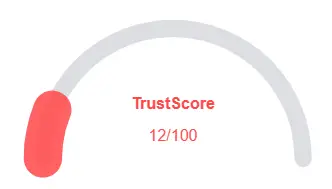
A website’s trust score is an important indicator of its reliability Trovenft.net includes low web traffic, negative user feedback, potential phishing risks, undisclosed ownership, unclear hosting details, and weak SSL encryption.
With such a poor trust score, the likelihood of fraud, data breaches, or other security issues is much higher. It is crucial to carefully assess these warning signs before engaging with a Trovenft.net Similar platform.
Positive Highlights
- We found a valid SSL certificate
- DNSFilter labels this site as safe
Negative Highlights
- The Tranco rank (how much traffic) is rather low.
- The age of this site is (very) young.
Frequently Asked Questions About Trovenft.net Review
This section answers key questions about Trovenft.net clarifies points, addresses concerns, and highlights issues related to the platform’s legitimacy.
It reviews the platform's business model, risks, and transparency.
It has transparency concerns, so do your own research before investing.
It claims to earn through NFT and crypto-related activities.
High ROI claims, limited transparency, and unverified information.
Both evaluate transparency, risks, and investment claims.
Other Infromation:
WHOIS Registration Date: N/L
WHOIS Last Update: N/L
WHOIS Renew Date: N/L
Website: Trovenft.net
Reviews:
There are no reviews yet. Be the first one to write one.