KTX Bank Review 2026: High-Yield USDT Staking or High-Risk Investment? A Straightforward Look
If you are searching for honest answers about KTX Bank and its USDT staking options, this review brings together clear facts from public site details. We focus on the compensation plan, what little is known about ownership, and how the numbers actually work. No hype, just simple language and real numbers so anyone can follow. For more scam analysis and platform risk research, you can also explore Scams Radar for related reviews and investor awareness content

Table of Contents
Part : 1 What KTX Bank Offers
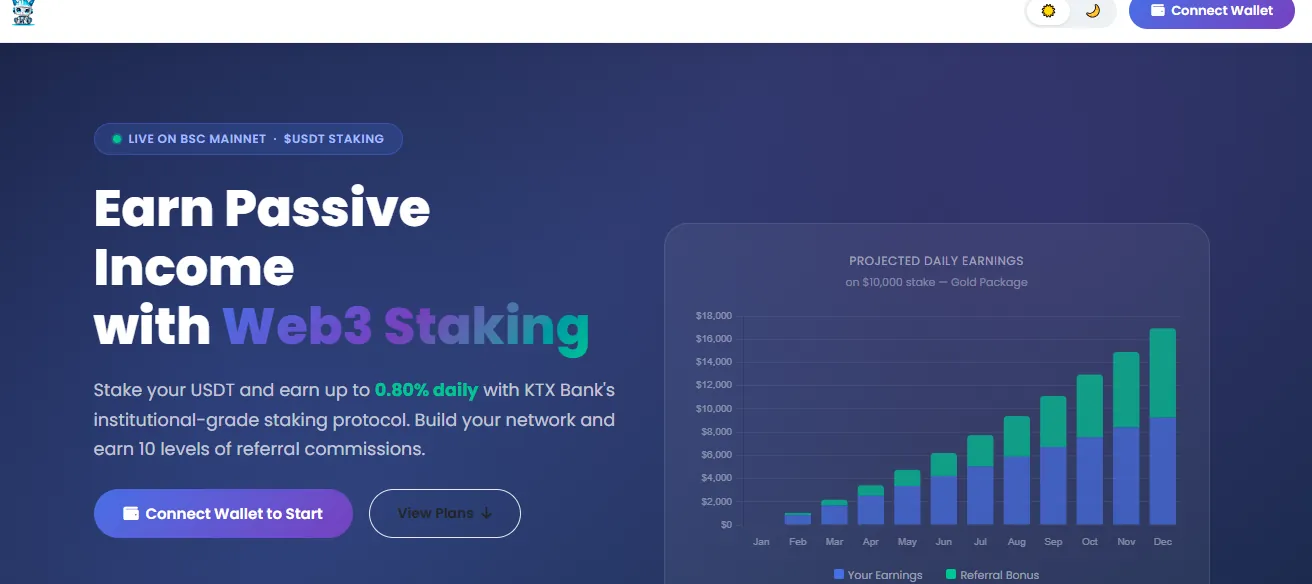
The platform runs on BSC Mainnet and lets users stake USDT (BEP-20) through wallet connect with MetaMask or SafePal. No email or password is needed — your wallet address becomes your account. Deposits appear instantly after on-chain confirmation.
Three staking tiers are available, all with a 365-day lock period:
- Silver: Minimum $100 USDT, 0.60% daily (claimed 219% APY), maximum payout 200% of your stake.
- Gold: Minimum $10,000 USDT, 0.70% daily (claimed 255% APY), maximum payout 230% of your stake.
- Platinum: Minimum $50,000 USDT, 0.80% daily (claimed 292% APY), maximum payout 270% of your stake.
Daily profits are credited automatically. You can withdraw only after hitting the maximum payout cap. The site’s own calculator shows that a $10,000 Gold stake would earn $70 per day and $23,000 total return (net profit of $13,000 after the cap). As of the latest visible stats, the platform reports 45 members and $60.9K total staked.
1.1 Complete Compensation Plan: More Than Just Staking
The earnings structure goes far beyond simple staking. It includes a full referral and ranking system that rewards recruitment heavily. Here is the breakdown in plain terms:
- Direct referral bonus: 5% commission on every stake your direct referrals make (for example, $500 on a $10,000 referral stake).
- Sponsor tier bonus (Level 1 only): Extra 10% to 30% based on the total volume of your direct referrals’ stakes. The tiers start at $500 volume (10%) and go up to $100,000 volume (30%).
- 10-level unilevel commissions: You earn a percentage of your downline’s daily staking profits across 10 levels:
- Level 1: 10–30%
- Level 2: 10%
- Levels 3–5: 5% each
- Levels 6–7: 3% each
- Level 8: 2%
- Levels 9–10: 1% each
- Rank milestone bonuses: Paid when your Level 1 referral volume hits certain targets, from Jade ($50K volume → $500 bonus) all the way to Imperial Diamond ($5M volume → $100,000 bonus plus 15 Global Pool shares).
- Global Pool profit share: Top ranks (Amethyst and above) receive shares of a platform-wide pool for ongoing passive income.
This setup makes recruitment the main way most users can earn significant extra money. The plan is a classic unilevel model — unlimited width on your first line, with payouts tapering down the levels. It is not a binary or matrix plan.
Rank | L1 Volume Needed | Bonus Amount | Global Pool Shares |
|---|---|---|---|
Jade | $50K | $500 | 0 |
Sapphire | $100K | $1,000 | 0 |
Emerald | $300K | $3,000 | 0 |
Ruby | $500K | $5,000 | 0 |
Topaz | $1M | $20,000 | 0 |
Amethyst | $2M | $30,000 | 5 |
Diamond | $3M | $40,000 | 10 |
Imperial Diamond | $5M | $100,000 | 15 |
Note: These figures come directly from the platform’s public descriptions.
Part : 2 Owners’ Profiles and Backgrounds
No individual names, photos, LinkedIn profiles, or company registration details appear on the site. The footer simply says “Powered by KTX Team.” There is no “About Us” page, no headquarters address, and no regulatory licenses listed (no SEC, FCA, or local Pakistani authorities mentioned). Domain records show the site was registered in September 2025 through a privacy-protected service, making ownership anonymous. This lack of transparency is common in newer platforms but makes it harder for users to hold anyone accountable.
2.1 Why the Numbers Raise Questions
Here is where things get important for everyday investors. Legitimate stablecoin yields in 2026 usually range from 3% to 16% APY on well-known platforms. The claimed 219–292% APY here is many times higher.
Simple math shows the challenge:
A $10,000 Gold stake at 0.70% daily needs the platform to generate roughly $70 every day just for that one user. Across the whole platform (with $60.9K staked), daily payouts could quickly exceed what typical low-risk DeFi strategies produce. When referral commissions and rank bonuses are added, the total obligation grows even more.
Real-world comparison (approximate annual returns):
- Bank savings in Pakistan: 5–11%
- Legitimate crypto staking: 3–16%
- Real estate: 8–12%
The platform promises 15–80 times those rates with fixed daily credits and a cap that stops payouts once you reach 200–270% of your stake. Early users may get paid from new deposits, but when new money slows, the structure becomes hard to sustain.
2.2 Traffic, Support, and Security Notes
The site is simple and mobile-friendly. It uses only USDT on BSC with wallet connect. No live chat, email support, or phone line is listed. No smart-contract audits, insurance, or fund-segregation details are shown. Content feels promotional and generic in places.
Final Thoughts and Advice
KTX Bank offers high daily percentage returns and a deep referral program that rewards bringing in new stakers. The compensation plan is detailed and recruitment-focused, with clear tiers, unilevel commissions, and big milestone bonuses. However, the anonymous ownership, brand-new domain, extremely high claimed yields, and lack of independent audits or regulation create real concerns for most investors.
If you are considering this platform, treat it as high-risk. Start only with money you can afford to lose completely. For safer USDT yields, look at established options like Binance Earn, Nexo, or Aave, which publish audits and lower but realistic rates. In Pakistan, licensed banks remain a steadier choice for most people.
KTX Bank Review Score
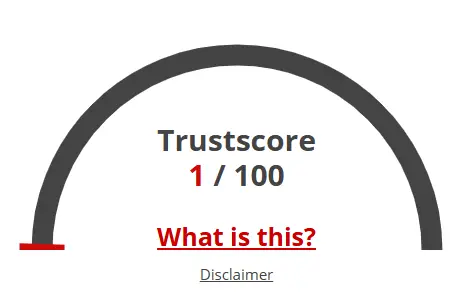
A website’s trust score is an important indicator of its reliability KTX Bank includes low web traffic, negative user feedback, potential phishing risks, undisclosed ownership, unclear hosting details, and weak SSL encryption.
With such a poor trust score, the likelihood of fraud, data breaches, or other security issues is much higher. It is crucial to carefully assess these warning signs before engaging with a KTX Bank or similar platform.
Positive Highlights
- We found a valid SSL certificate
- DNSFilter labels this site as safe
Negative Highlights
- The Tranco rank (how much traffic) is rather low.
- The age of this site is (very) young.
Frequently Asked Questions KTX Bank.
This section answers key questions about KTX Bank. clarifies points, addresses concerns, and highlights issues related to the platform’s legitimacy.
KTX Bank presents itself as an online investment platform offering returns through crypto-related plans and referral-based earnings.
KTX Bank should be approached with caution because investors need to verify its transparency, ownership, and withdrawal reliability before joining.
KTX Bank claims users can earn passive income, but such promises should always be checked against realistic market returns and platform credibility.
Common red flags include unrealistic ROI claims, unclear company information, and strong dependence on recruitment or referral commissions.
Compared with insights people look for in Everstead Review, KTX Bank should be judged on transparency, sustainability, and whether its profit model is realistic
Other Infromation:
WHOIS Last Update Date: N/L

Reviews:
There are no reviews yet. Be the first one to write one.